Study Guide
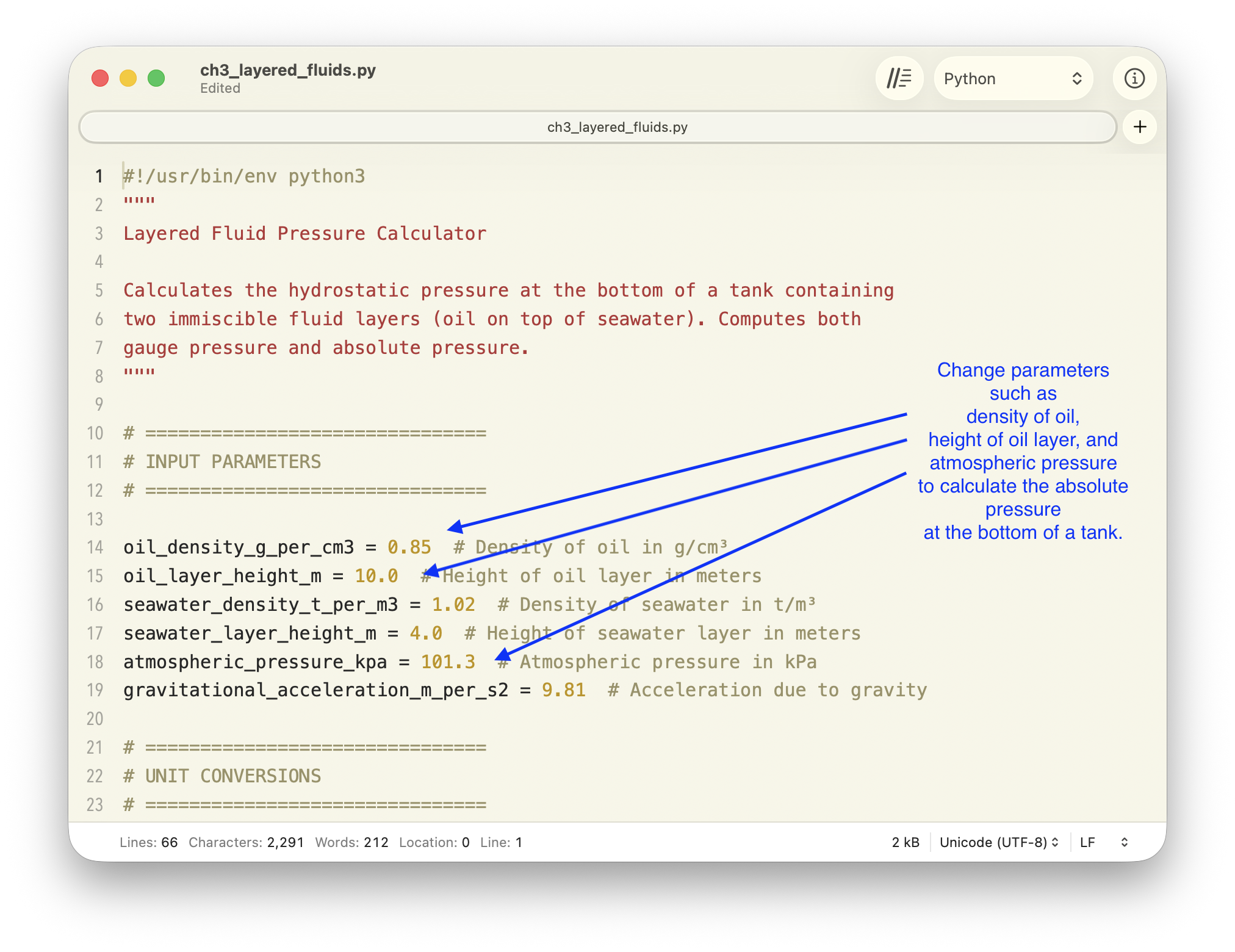
First and foremost, solve the problem sets using only pen, paper, and a calculator. After completing a problem by hand, slightly modify the conditions or variables (Figure 1) and solve it again. Then, input the new values into the Python script and compare the results with your hand-calculated solution.
Buddy system: Study with a classmate. Teaching and helping one another significantly deepens understanding of the material. Students are strongly encouraged to work through problem sets collaboratively. For example, one student solves the odd-numbered problems while the other solves the even-numbered ones; then each explains their solutions to the other.
Practice, practice, practice: As the saying goes, “practice makes perfect.” More accurately in this context, “good practice makes perfect.” That means pen-and-paper-first practice. Use Python as a verification tool, not a crutch. Always derive the solution analytically on paper first. Only after obtaining a complete hand-calculated result should you run the corresponding Python script. This approach echoes a proverb commonly attributed to Confucius:
I hear and I forget
I see and I remember
I do and I understand
Maintain a solution notebook: For each major problem, keep a single document (physical or digital) containing:
- The full hand derivation
- Key numerical results with units
- A brief paragraph summarizing insights or reconciling any intermediate discrepancies
This record becomes an invaluable review resource before exams.
- The full hand derivation